DOROMA - When a Dream Was Given a Name
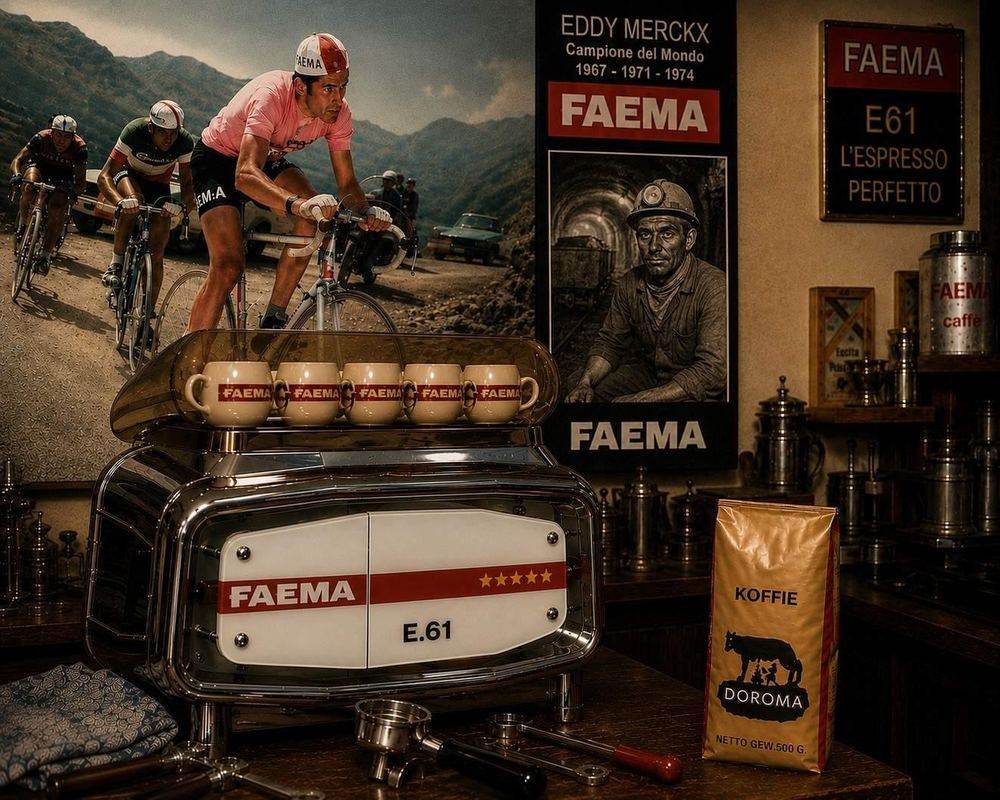
Some companies are born after months of preparation and market research. Others come into being because life suddenly forces you to search for another road. That is how DOROMA was born. At the end of 1974, I returned to FAEMA's Belgian subsidiary. My adventure at Groupe Riem had lasted barely six months. I returned to a world I knew well. Coffee. Espresso machines. The hospitality industry. And above all, the customers. This time, I returned not as a technician, but as a salesman.
I quickly discovered that sales suited me especially well. Not because I knew how to force something on people. I never considered that to be selling. To me, selling began with listening. Understanding what a customer truly needed. Looking for a suitable solution. And above all, keeping my word. Perhaps that is why my results were so good. I became FAEMA's best salesman in Belgium. My figures were rewarded with premiums and bonuses for the exceptional results I achieved.
For a young man with a family, that meant a great deal. Not only financially. It also gave me confidence. I began to understand that the knowledge I had acquired over the years had genuine value. I knew the world of coffee. I knew the machines. I knew the hospitality industry. And above all, I knew the customers. It seemed I had finally found my place.
But life taught me more than once that precisely when everything seems to be taking on a stable shape, an event can force us to begin again. During the 1970s, FAEMA sank deeper and deeper into difficulties in Italy. In 1977, the company as it then existed ultimately went bankrupt.
To my colleagues and me in Belgium, this meant far more than the disappearance of an employer. FAEMA was the company where my love of espresso had been born. The place where I learned my profession. Where, first as a technician and later as a salesman, I discovered a world that would remain an important part of my life. And suddenly, that security disappeared. The consequences were soon felt. Customers no longer knew what they could count on.
The orders I had obtained through so much effort were canceled one after another. What seemed like a certain sale one day could disappear completely the next. With the orders, it was not only revenue that vanished. My income and my family's security were also at risk. I now had a wife and two young sons. Marco was not yet five. Michael had just been born. We had a house. A loan.
Bills. A family for whom I was responsible. I could not afford to wait and hope everything would resolve itself. I had to find other ways to earn our living. DOROMA was my first choice. The idea of building something myself had lived within me for a long time. At FAEMA, I had discovered the soul of espresso. At Douwe Egberts, I had seen the importance of quality, organization, and innovation.
At Groupe Riem, I had learned to measure and analyze commercial results. And during my second period at FAEMA, I had proven that I knew how to sell. That I could persuade customers through knowledge, service, and trust. So when FAEMA disappeared, I faced a choice. I could look for a new employer. Or I could try to follow my own road. That decision was not simple.
Following a dream often seems more romantic in hindsight than it truly feels at the time. When you have a wife and two young children, you do not think only about what might succeed. You also think about what might fail. The home loan. The bills. The food that must be put on the table. Your children's future.
But I also knew I possessed something no one could take from me. My experience. My knowledge. My contacts with customers. My willingness to work hard. And my conviction that I could build something myself. So I decided to launch DOROMA on the market. I had already imagined the name before Michael was born. It had not been chosen by chance. DOROMA carried my family within it. DO stood for Dorina. RO stood for Rossi.
And MA stood for Marco. Together, those three parts formed a single name: DOROMA. To someone else, it may have been only the name of a coffee brand. To me, it meant far more. My wife. My family name. My first son. My family. And my first true attempt to build something through my own efforts. The logo I chose for DOROMA also referred to my Italian origins. The she-wolf.
An image inseparable from Rome and the story of Romulus and Remus. I wanted my coffee to express an Italian identity. Not only through its name. But also through its image. Its appearance. Everything the brand represented. In my eyes, DOROMA had to be far more than coffee in a package. It had to possess a soul.
But at almost the same moment I launched DOROMA, a second possibility unexpectedly appeared. My cousin Leonardo imported ceramic tiles directly from Italy. He asked whether I wanted to work with him to sell them in Belgium. The world of ceramics was completely unknown to me. I knew coffee. I knew espresso machines. I knew the hospitality industry.
But at that moment, I knew almost nothing about ceramic tiles. Leonardo probably saw something in me, however, that I did not yet fully recognize myself. He knew I could sell. That I connected with people easily. That I was willing to study a product thoroughly before presenting it to customers. And above all, he knew I was not afraid to begin again.
His proposal also arrived at a time when I did not have the luxury of simply setting possibilities aside. DOROMA was my first choice and remained a project in which I deeply believed. But I also had to think practically. My family needed security. So I decided to combine the two activities. DOROMA and ITALIA IN. Coffee and ceramic tiles. Two completely different worlds. For several years, I worked in both activities at the same time.
With DOROMA, I remained connected to the world I knew best. With ITALIA IN, I took my first steps in a sector that would later play an especially important role in my life. At that moment, I did not know where those two roads would lead. Above all, I was trying to move forward. When you are self-employed, you cannot rely on a large organization. You are the organization. Suddenly, I had to think about everything.
Purchasing. Sales. Customers. Inventory. Deliveries. Invoices. Payments. Accounting. And meanwhile, I had to return to the road every day. There were days when twenty-four hours simply did not seem enough. But there was one great difference from the past. Every step I took, I now took for myself and my family. Every new customer gave me confidence. Every order meant far more than revenue.
It told me: perhaps I truly can do this. Dorina experienced this adventure at close range. She saw the hours I worked. She saw my enthusiasm. But she also knew my worries. Because behind every beginning entrepreneur's dream lies a reality discussed far less often. The nights spent awake. The invoice not yet paid. The customer who hesitates. The order you were counting on that ultimately does not materialize.
The question of whether you made the right decision. And above all, the responsibility toward those who are counting on you at home. When uncertainty sometimes weighed too heavily, I thought of my parents. Of my father.
He had come to Belgium and descended deep beneath the earth to work, with no guarantee that his dream would succeed. He had only one conviction: his children had to know a better life. My mother had taught me the same lesson in her own way.
Do not give up when things become difficult. Perhaps that attitude was rooted more deeply within me than I understood at the time. In the beginning, DOROMA and ITALIA IN were small activities. Very small, in fact. But to me, they were great. Not because of their revenue. Not because of their profit. But because of what they represented. Freedom. Responsibility. And the possibility of working according to my own convictions.
When I think back on that period today, I see a strange paradox. FAEMA's bankruptcy seemed nothing but a serious setback. It had taken away a job in which I had performed especially well. I had become FAEMA's best salesman in Belgium. I earned a good living. I received premiums and bonuses. Why would anyone voluntarily give all that up?
But I had not been given that choice. Life had made it for me. The orders disappeared. Security collapsed. I had to find another way to provide for my family. That was precisely what forced me to open doors I might otherwise have left closed for years. Behind the first was DOROMA. My own coffee brand. A name in which my family lived. A she-wolf that reminded me of my Italian roots.
Behind the second door was ITALIA IN. My first encounter with the world of Italian ceramic tiles. A world whose importance in the rest of my life I could not possibly foresee. For several years, I tried to keep both doors open. I sold coffee. I sold tiles. I learned. I searched. I built. And day after day, I tried to earn enough to give my family the security FAEMA's bankruptcy had suddenly taken away.
I could not yet know what would ultimately become of DOROMA and ITALIA IN. That story belonged to later. At that moment, I was doing what I had always done when life placed a problem before me. I did not wait for someone else to bring me a solution. I went looking for it myself. We understand some setbacks only many years later. At the time, we see only what we are losing.
Only afterward do we sometimes discover the new roads they opened before us. For me, those roads bore two names. DOROMA. And ITALIA IN.