Chapter 9 When I Had to Leave My First Home
Some farewells last only a few minutes. And yet we carry their meaning within us for the rest of our lives. That is how I felt when we left my De Lindeman community. I was about twelve years old. To many adults, at that age you are still only a child. But to a twelve-year-old boy, it is already an entire world. At that age, I did not yet understand how deeply a place can become part of you. I only knew that we were moving. My parents had their reasons. My father had worked hard for years. Life was changing. A new chapter was beginning for our family. But as a young boy, I did not think about any of that. I thought about my friends. The street where I had learned to ride a bicycle. The houses whose every front door I knew. The familiar voices that echoed through the neighborhood each evening.
And suddenly, I had to leave all of it behind. I still remember those final days very clearly. You look at the street one last time. The trees. The church. The houses. You promise yourself you will remember every detail forever. And yet over the years, many of those details fade. What remains is the feeling. We moved to Liège. For my parents, it was the beginning of a new chapter. To me, it felt as though I were leaving part of myself behind. Suddenly, I heard other languages. I discovered other customs. I met new people. Once again, I had to find my place. In De Lindeman, everyone knew me. In Liège, no one outside my family knew me. Meanwhile, my father continued working at the Zolder mine.
He still had to repay the debts he had incurred so that his two oldest sons, Remo and Mario, could study at a technical boarding school in Seraing. That is why he stayed in De Lindeman during the week. Every weekend, he returned home to us, and every Sunday evening he left again for De Lindeman so he could resume work at the mine the next day. He continued this way until 1963. It may sound like a small thing. But to a twelve-year-old boy, it is like having to learn to breathe all over again. I quickly discovered that not everyone welcomed a newcomer with open arms. Some children mocked my origins. My name. And especially the fact that I did not yet speak French. So I asked my parents whether I, too, could attend boarding school in the Ardennes. I wanted to learn French as quickly as possible and find my place in this new world.
Sometimes I laughed along with the others. But deep inside, certain words hurt me. Not because children are cruel by nature. Children often repeat what they hear at home. I understood that only much later. Nevertheless, that period taught me something that remained with me throughout my life. I learned how it feels to be different. Perhaps that is why, later, I always tried to make sure no one felt excluded. Throughout my professional life, I met people from many countries. Those differences never frightened me. On the contrary. I always felt at home among different languages and cultures. Perhaps because my childhood had already taught me that behind every accent is a human being. Behind every unfamiliar name, a family. Behind every immigrant, a story. Today, I sometimes hear immigration discussed as though it were only a matter of numbers.
To me, they are not numbers. They are faces. Mothers saying goodbye. Fathers leaving home. Children having to leave their friends behind. I know what that means. Because I lived it myself. I do not want this to be a chapter of sadness, however. Liège also gave me a great deal. New friends. New experiences. New possibilities. And it was ultimately there that a large part of my life truly began. My first job. My dreams. My failures. My victories. When I look back today, I understand that life sometimes asks us to give something up before it can offer us something else. I had to leave my first home before I could find my second. I did not understand it at the time. Today, I do. And perhaps that is the most beautiful gift memories can give us. Only many years later do they allow us to understand why certain moments in our lives were necessary.
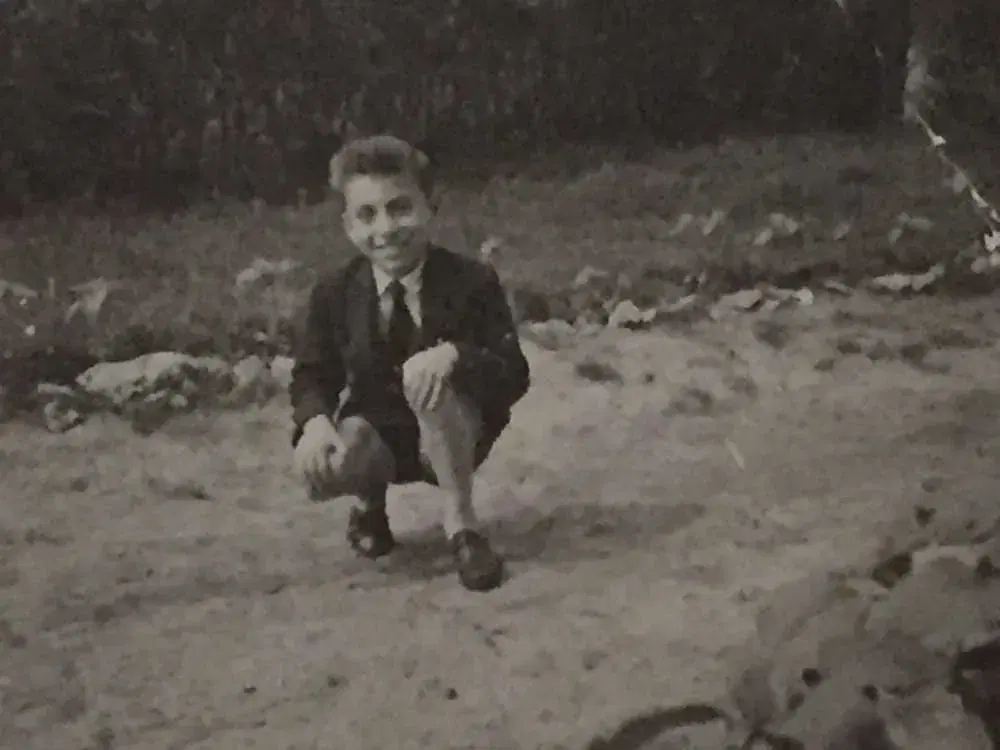
Me at the age of ten at the De Lindeman mining estate.
The boy leaving De Lindeman could not possibly imagine the road still waiting ahead. And yet he took that first step. Not because he was especially brave. But because life was gently pushing him forward. And sometimes that is how a new chapter begins. In 1960, we left my De Lindeman community and moved into a house near Liège. Our new home stood beside the railroad tracks leading to Liège-Guillemins station. The station itself was a few miles farther away. Everything was still new to me. The surroundings. The language. The people. And soon after we moved, the country around us also became restless. During the winter of 1960-1961, the great strikes against the Unitary Law began. I was twelve years old. I did not yet understand exactly what that law contained. I knew nothing of the political debates. But I saw what was happening very close to our home.
Belgian soldiers patrolled the railroad tracks day and night. They marched with weapons in hand. To a twelve-year-old boy, it was an impressive and frightening sight. Until then, I knew soldiers mainly from stories and films. Now they were marching right beside our house. Not in some distant country. But along the tracks we looked at every day. During the daytime, I could follow their movements. At night, too, their presence remained noticeable. The railroad, which had usually been just part of our surroundings, suddenly took on another meaning. It was being guarded. As though something might happen at any moment. The strike paralyzed much of Wallonia. For many workers, their jobs, income, and future were at stake. I understood that only later. As a child, I mainly saw the consequences. The tension among people. The uncertainty. And the armed soldiers who continued patrolling the tracks.
Security could not be taken for granted within our own family either. My father still worked at the Zolder mine and stayed in De Lindeman during the week. Meanwhile, we were trying to build a new life in Liège. The world into which I had arrived was very different from the protective community I had left. In my community, everyone knew one another. Here, I discovered how quickly a society could become divided and agitated. Perhaps it was one of the first times I understood that politicians’ decisions do not remain confined to meeting rooms. They end up in the streets. In factories. In families. And even along the railroad tracks outside a twelve-year-old boy’s home. I do not want to turn this memory into a political lesson. I was too young for that then, and the events are too complex. I am only telling what I saw. Soldiers.
Day and night. Along the railroad. Weapons in hand. An image that stayed with me after all these years. Not because I understood then what the Unitary Law meant. But because, for the first time, I saw the great course of history suddenly appear right outside my own door.