Chapter 4 The Cité That Taught Me Togetherness
My earliest memories take me back to the Lindeman mining community in Heusden-Zolder. When I close my eyes today, I do not see streets or houses. I see people. I hear children laughing. I smell freshly baked bread. I hear mothers calling to one another from doorway to doorway. I see the miners slowly returning home, exhausted after a long day deep beneath the earth. For us children, the mining community was the entire world. We had no computers. No cell phones. No Internet. Our greatest wealth was the street. We played outdoors for hours. A single ball was enough to keep us happy for an entire afternoon. Everyone knew everyone. When a child had misbehaved, his mother often knew before he even reached the front door. At the time, that sometimes annoyed us. Today, I understand how much security it gave us.
We did not grow up only within our own families. We grew up as members of a true community. My father worked in the coal mine. Like thousands of other Italian fathers, he rose before dawn each morning to descend into a world where sunlight did not exist. As a child, I gave it little thought. To me, it was simply my father’s work. Only much later did I truly understand the dangers he faced every day. He rarely spoke about them. Like so many men of his generation, he carried his worries in silence. My mother was the heart of our family. Despite our modest means, she made sure we never felt that we lacked anything. She taught me that dignity has nothing to do with wealth. You can possess very little and still give so much. I watched her embody that truth every day of her life.
Families from different regions of Italy lived on our street. Each spoke its own dialect. And yet we understood one another. Perhaps because we all shared the same dream: to give our children a better life. I can still remember the aromas of Sunday morning. The smell of coffee. Of tomato sauce slowly simmering on the stove. Of fresh bread. Even today, those aromas mean home to me. Sunday was a special day. We put on our finest clothes. After Mass, families gathered. People talked. Laughed. Sometimes they even sang. No one owned very much. And yet no one felt poor. As children, we never questioned it. Happiness seemed natural. One of my fondest memories is of our outings to the cinema. For only a few Belgian francs, we could escape into stories that carried us far beyond the world we knew.
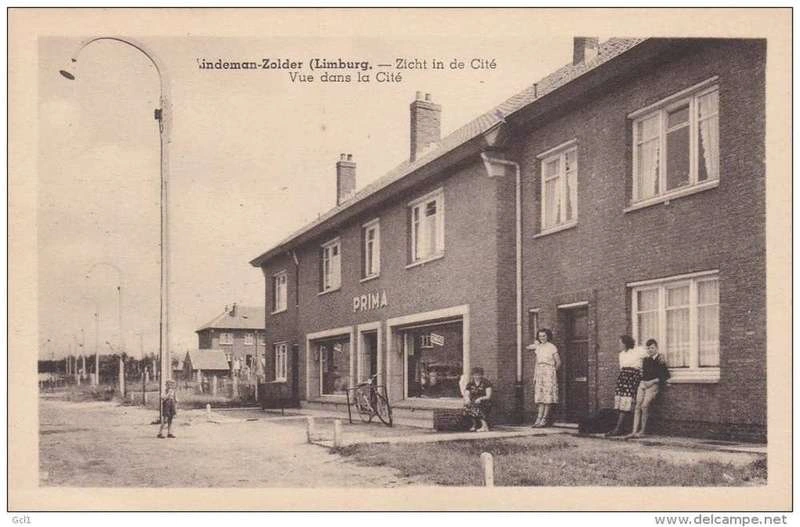
The De Lindeman mining estate, the first home that taught me what living together meant.
Afterward, we often went out for fries. They were simple moments. But today I understand that happiness is rarely complicated. It was also during those years that I became an altar boy. I was still very young, but the church filled me with wonder. Not only because of the ceremonies. But also because of the silence. The candles. The incense. And the feeling that there might be something greater than what our eyes could see. At that age, I did not yet understand it. But perhaps a small seed was planted deep within me then. The seed of the questions that would accompany me throughout my life. Who are we? Why are we here? Does chance truly exist? Or is there sometimes a deeper meaning hidden behind events that we discover only many years later? At the time, I did not know the answers. Perhaps I still do not know them today.
But I do know one thing. I have never lost my capacity for wonder. When I think back on my childhood, modest circumstances are not the first thing that comes to mind. Nor hardship. Not even the coal mines. I think of human warmth. Of solidarity. Of people who truly cared for one another. Perhaps that is the greatest difference between their time and ours. Today, we possess much more. But I sometimes wonder whether we still truly know one another as we once did. Our mining community may have been small. But it was large enough to teach me some of the most important lessons of my life. That respect cannot be bought. That friendship has no price. And that a person becomes rich not through what they possess, but through the people for whom they make room in their heart. Those lessons have never left me.
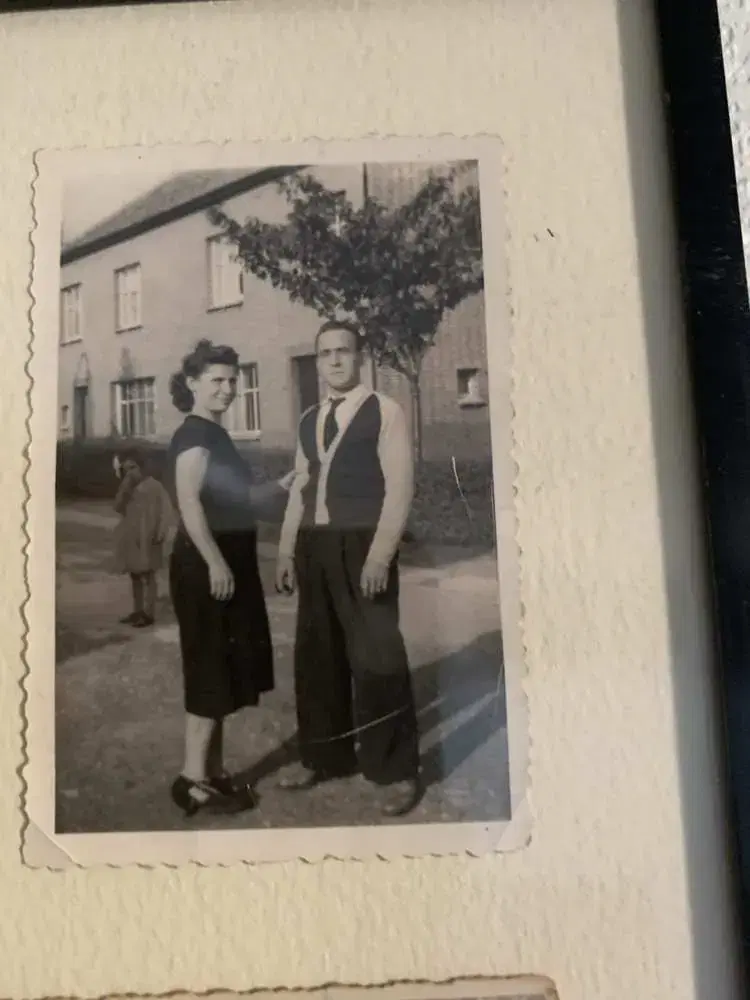
My mother Guglielmina and my father Antonio at the De Lindeman mining estate in Heusden-Zolder.
In the mining community, we learned the value of money without anyone giving us a lesson about it. For five francs we could go to the cinema; for three francs we bought fries. An evening like that felt like wealth. We watched the screen, shared what we had, and then walked home through the same streets. No one took photographs of those ordinary outings. Yet I see them more clearly than many solemn occasions that came later.
Our games were not always innocent. One day, while we were roughhousing, a rope tightened around my brother Carmine’s neck. What seemed like a joke became dangerous within seconds. The fear came only when I understood what could have happened. I do not tell this to make my childhood seem darker, but because such a mistake also belongs to a real youth: we were free, sometimes careless, and had to learn by experience where play ended and responsibility began.
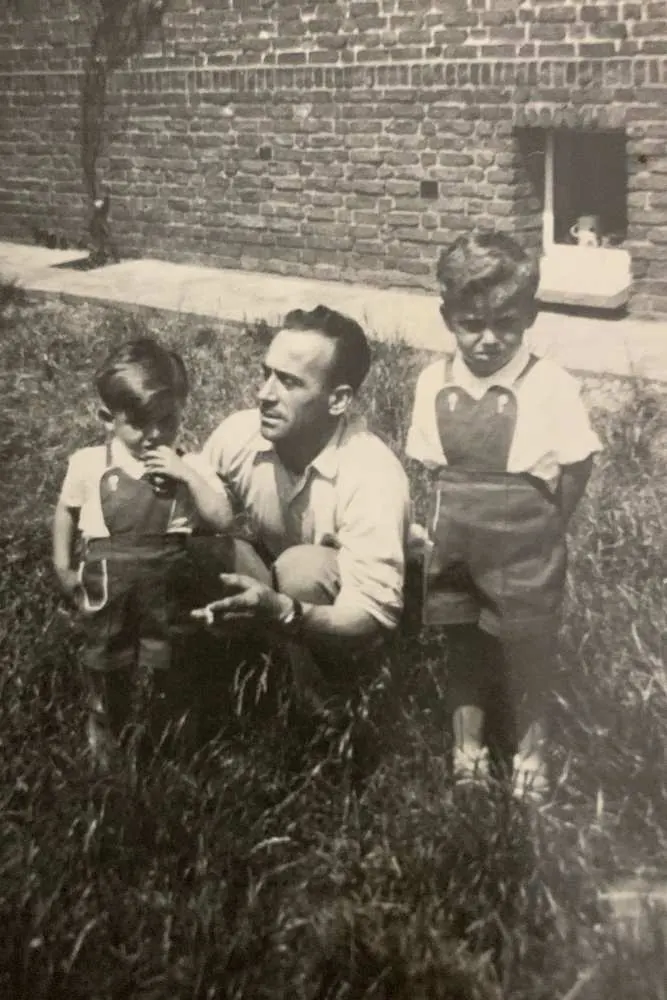
My father Antonio with two of his sons at De Lindeman.
I was curious and enterprising, but certainly not a model child who always knew what was right. I could be stubborn, go too far, and understand only afterward what I had done. Perhaps that is precisely where my tendency not to look away after a mistake began. Shame helps no one move forward; honestly acknowledging what happened can, however, be the beginning of change.